Surviving Hepatitis C in AZ Jails, State Prisons, and Federal Detention Centers.

Surviving Hepatitis C in AZ Jails, State Prisons, and Federal Detention Centers.
The "Hard Time" blogspot is a volunteer-run site for the political organization of people with Hepatitis C behind and beyond prison walls, their loved ones, and whomever cares to join us. We are neither legal nor medical professionals. Some of us may organize for support, but this site is primarily dedicated to education and activism; we are fighting for prevention, detection, treatment, and a cure for Hepatitis C, particularly down in the trenches where most people are dying - in prison or on the street... Join us.

---------------------------------------------------------------
Showing posts with label board of executive clemency. Show all posts

Saturday, July 3, 2010

This is my friend, Davon.

This is a recent letter from my friend, Davon Acklin. He doesn't mention the campaign going on for him out here, but I know he's worried about the other guys there who are sicker than him; as Julie said at one point, this is about them, too.

We need to push on the clemency process so people don't have to die in prison who weren't sentenced to do so. We need more transparency and public dialogue about the treatment of hepatitis C in both the community and our human warehouses (prisons, schools, shelters, hospitals...). We need to make sure that health care is adequate in the prisons. And we need to bring home the sick and dying.


Anyway, this is the good soul I know Davon to be, describing the daily challenges of getting by in prison, worrying about how I was
doing in the wake of a recent assault, and talking about having to always look tough in there to keep himself safe. He talks about his sister growing up, and what a terror he was at her age, and how he needs to be a good influence on his little sister, who looks up to him.


Here's a picture of Davon looking tough in his prison orange. He does a good job of it when he has to, but he's a real sweetie. That's why I'm posting this letter, which you can barely make out but you should get the gist of - he was worried about how I'd been getting along, and really touched that I brought his dad, Greg, down for a visit. He can't wait to see his sister and Mom, Not a mention of being sick; I think in a way he's a little uncomfortable with all this attention.

Despite his discomfort with being a poster child for prisoners with Hep C, Davon gave us his blessings to use our own discretion in all this organizing and activism around him because he thinks that by advocating for him his mom will end up helping the other guys he sees there. That's precisely what she's hoping to do.

Given the stigma associated with infectious diseases like HIV and Hepatitis (not to mention a psychiatric disability and a record as a violent criminal) I think that's a pretty courageous position for a young prisoner to take. Davon will be forever Googled back to these pages, with his mom and her friends laying out this crisis in his life for the world to see and judge - something he's willing to risk if doing so will help others.

Now, does that sound like a dangerous criminal? We call that 'lifting as we climb'. That's how we make sure we don't leave anyone behind in this revolution...

The ADC can cause Davon all sorts of grief if they want to, of course, but I don't think they'll stoop to that - it isn't necessary or productive, and it'll just set Julie off on them again. She's trying to focus on building membership in his facebook cause and getting his petition signed for the AZ Board of Executive Clemency right now, and if she's successful then she'll be out of the ADC's hair soon enough. It would be in their best interests to make every effort to help her succeed, not get in her way.

So, hit those links up there for us, and join and sign and spread the word. It's important to show that Davon has a community to come home to that will embrace him and help him keep both his liberty and his sanity. That community is global, now - Davon has friends he hasn't met yet as far away as the Netherlands. His community of correspondents are especially important for the Clemency Board to get personal letters from (in addition to signing the petition), no matter where you may be in the world.

Please help us free Davon.

Thanks for
your time.

- Peggy Plews

Sunday, June 27, 2010

The dying, prison, and Adam Montoya.

For those who still think that prisoners get great medical care, think again. This is not an unusual story...sounds like Marcia Powell's.

If you wish you could have helped this guy - or Marcia Powell, for that matter - and want to know how to make a difference here: please take a minute and help someone still living. Free Davon Acklin. That will take you straight to the petition his mom has going supporting her request that he be pardoned by Governor Brewer so she can bring him home for medical care.

He's only
23, and he has hep C and needs a liver biopsy. He's not getting treatment at the ADC, either, so your time and good name for the cause would be appreciated.

------------------from Salon.com-----------------------

Ill. inmate died in agony while pleading for help

For days before he died in a federal prison, Adam Montoya pleaded with guards to be taken to a doctor, pressing a panic button in his cell over and over to summon help that never came.

An autopsy concluded that the 36-year-old inmate suffered from no fewer than three serious illnesses -- cancer, hepatitis and HIV. The cancer ultimately killed him, causing his spleen to burst. Montoya bled to death internally.

But the coroner and a pathologist were more stunned by another finding: The only medication in his system was a trace of over-the-counter pain reliever.

That means Montoya, imprisoned for a passing counterfeit checks, had been given nothing to ease the excruciating pain that no doubt wracked his body for days or weeks before death.

"He shouldn't have died in agony like that," Coroner Dennis Conover said. "He had been out there long enough that he should have at least died in the hospital."

The FBI recently completed an investigation into Montoya's death and gave its findings to the Justice Department, which is reviewing the case. If federal prosecutors conclude that Montoya's civil rights were violated, they could take action against the prison, its guards, or both. A Justice Department spokesman declined to comment, saying that the matter was still being investigated.

The coroner said guards should have been aware that something was seriously wrong with the inmate. And outside experts agree that the symptoms of cancer and hepatitis would have been hard to miss: dramatic weight loss, a swollen abdomen, yellow eyes.

During Montoya's final days, he "consistently made requests to the prison for medical attention, and they wouldn't give it to him," said his father, Juan Montoya, who described how his son repeatedly punched the panic button. Three inmates corroborated that account in interviews with The Associated Press.

The younger Montoya was taken to the prison clinic one day for "maybe five, 10 minutes," his father said. "And they gave him Tylenol, and that was it. He suffered a lot."

The federal prison in Pekin will not discuss Montoya's death. Prison spokesman Jay Henderson referred questions to the Bureau of Prisons, which denied an AP request for information on Montoya's medical condition, citing privacy laws.

It isn't clear whether the prison system, relatives or even Montoya himself knew the full extent of his illness. Montoya's father had no idea his son had cancer or hepatitis. Inmates who knew him said he told them he had cancer, but they knew nothing of his HIV.

According to its website, the Bureau of Prisons tries to screen the health of new inmates within 24 hours of their arrival. A closer examination within two weeks is required for prisoners with serious, long-term illnesses. But officials have not said whether Montoya was given any kind of exam or whether his medical records made it to Pekin.

Montoya pleaded guilty in May 2009 to counterfeiting commercial checks, credit cards and gift cards. Prosecutors will not say how much money was involved in the scheme, but Montoya was ordered to pay a little over $2,000 in restitution.

Montoya, who had a history of methamphetamine abuse, was released while awaiting sentencing and was ordered not to use drugs. At the time, he was living with his father and working for his father's process-serving business, which delivers legal documents. His father said he was paying Montoya's bills and paying him about $300 a week.

Then in mid-June, Adam Montoya was diagnosed with HIV.

"It hit him like a ton of bricks," his father said.

After the diagnosis, Montoya retreated back into methamphetamine. Following a urine test, he admitted using the drug three times in a month, and he was locked up.

Montoya began taking antiviral drugs, so his father still had hope and tried to give his son a sense of the same. "I thought, 'You'll get out. You'll get your probation, and you'll have years of life," the elder Montoya said.

In mid-October, Montoya was sentenced to two years and three months in prison. When he arrived at a federal prison transfer center in Oklahoma City, his medication was waiting for him. His father took that to mean that the prison system knew Montoya suffered from HIV.

Montoya arrived at the Pekin prison on Oct. 26. He lived just 18 more days. The inmates around him say he spent much of that time pleading for help from his cell.

Prison staff told Montoya he had the flu, according to Randy Rader, an inmate in the next cell who wrote letters to his mother about Montoya and discussed him in an e-mail interview with the AP.

"That man begged these people for nine days locked behind these doors," Rader wrote to his mother on Nov. 14. The letter was first obtained by The Pekin Daily Times, which wrote about Montoya's death earlier this year.

Rader has since been moved to a prison in California -- far from his family in Michigan. He suspects the move was retaliation for speaking out about Montoya.

The last time a staff member visited Montoya, about 10 p.m. on Nov. 12, he reported having trouble breathing and complained that he could no longer feel his fingers, Rader said in the e-mail interview. The staff member told Montoya that he would try to get help the next day.

Around 6:30 a.m., prison officials found Montoya's body in his cell.

The autopsy showed that Montoya's spleen was almost 10 times the normal weight because it had been engulfed by a cancerous tumor, which was on its way to doing the same with his liver.

The pathologist who examined Montoya's body said his eyes were also yellow -- an unmistakable sign of hepatitis. Dr. John Ralston is reluctant to speculate whether treatment could have saved Montoya's life by the time he reached Pekin. The doctor suspects he would have needed a liver transplant to have a chance.

That said, "You would think that he would have been feeling bad enough and complaining enough that somebody should have tried to get to the bottom of this," Ralston said.

The AP sought opinions about Montoya's condition from other doctors who did not examine him but were familiar with his diseases. They agreed he probably displayed obvious signs of distress.

Montoya would have had a swollen abdomen because of his spleen. At the same time, he probably was losing weight rapidly because the large tumor would have left little room in his belly for food, according to Dr. Krishna Rao, an assistant professor of oncology at Southern Illinois University Medical School in Springfield.

Someone in Montoya's condition should have been taking heavy doses of chemotherapy for his cancer or receiving stem cell transplants, if he were healthy enough, said Dr. James Egner, an oncologist with the Carle Foundation Hospital in Champaign.

If the cancer was too advanced, Montoya should have at least been treated for pain with powerful drugs, possibly in a hospice, Egner said.

The president of the American Civil Liberties Union's National Prison Project said it isn't uncommon for medical records not to arrive with a federal inmate.

"Sometimes it arrives late, and sometimes it doesn't happen at all," said David Fathi, who has spent 15 years studying prison conditions. "That's why it's so critical that the new facilities do a medical screening" of new inmates.

Fahti said Montoya's death "is really an egregious failure, of the kind that you wouldn't expect from even a small county jail, let alone the largest prison system in the United States."

After his son's death, Juan Montoya wrote to the prison complaining about its medical care. Warden Richard Rios wrote back to defend his institution.

"I must respectfully disagree with your characterization of the medical care Adam received and want to assure you that we carefully monitored you son's medical condition," wrote Rios, who was not hired for the job until months after the death. He did not elaborate, writing that privacy laws limited what he could say.

The elder Montoya is now waiting for his son's medical records, but he doubts they will offer many clues. The family has hired lawyers but has not decided whether to file a lawsuit.

Montoya thinks a lot now about the assurances he offered his son as he headed for prison.

"Your time will go by fast, and you'll get out, and we'll get you a job and be part of the family," Montoya recalls telling his son. "It never happened."

Thursday, June 24, 2010

Making the case: Extraordinary and Compelling.

Ethical and legal issues regarding federal compassionate release. Interesting article - worth reading the rest.

-------------------

EXTRAORDINARY AND COMPELLING:
A RE-EXAMINATION OF THE JUSTIFICATIONS FOR
COMPASSIONATE RELEASE
WILLIAM W. BERRY III*
Maryland Law Review
17 June 2009


I. INTRODUCTION
“Justice is the tolerable accommodation of the conflicting interests of society, and I don’t believe there is any royal road to attain such accommodation concretely.”—Judge Learned Hand1

Conflicting interests lie at the heart of the sentencing process. Not limited to the obvious competing interests of the state and the offender, the state’s broader punishment interests can often conflict.

The state’s interest in giving an offender his just deserts, for instance, competes with its interests in deterring others from committing the same crime, incapacitating the offender to protect society, and rehabilitating the offender.2 The battle for supremacy between such interests often occurs when a judge considers whether certain evidence is grounds for mitigating a sentence.3

Although parole was abolished with the passage of the Sentencing Reform Act of 1984,4 the potential for mitigating a federal sentence does not end with the sentencing decision of the federal trial judge. Rule 35(b) of the Federal Rules of Criminal Procedure authorizes the court, upon motion by the government, to reduce the sentence to reflect substantial assistance provided to the government by the defendant after the sentence became final.5 In addition, where the United States Sentencing Commission has subsequently reduced the guideline range used to sentence the defendant, the court may reduce the sentence upon a motion by the defendant or the Director of the Bureau of Prisons.6

Federal law, unbeknownst to many, includes another stipulation that authorizes the immediate release of federal prisoners. This safety valve provision demands that the Director move on behalf of the prisoner to secure the prisoner’s compassionate release.7 Not a veiled version of parole, this compassionate release provision is only to be used in circumstances deemed “extraordinary and compelling.”8 The Bureau of Prisons has read this language very narrowly for many years, considering only terminally ill inmates as candidates for compassionate release.9 In November 2007, however, the Sentencing Commission modified its Commentary to the Sentencing Guidelines, defining for the first time criteria for determining circumstances that should be deemed “extraordinary and compelling.” Specifically, the Commission’s new Commentary provides that extraordinary and compelling circumstances can include: (1) terminal illness, (2) debilitating physical conditions that prevent inmate self-care, and (3) death or incapacitation of the only family member able to care for a minor child.10

In addition, the Commentary provides that compassionate release may be granted where, “[a]s determined by the Director of the Bureau of Prisons, there exists in the defendant’s case an extraordinary and compelling reason other than, or in combination with, the [three] reasons described [previously].”11

As explained below, the Bureau of Prisons has ignored, in many ways, the broader statutory language as well as its own regulations in its decision to limit the application of “compassionate release” to prisoners who are terminally ill. By limiting the use of the safety valve to cases of “medical parole,” the Bureau eschews the more difficult categories of prisoners who, for one of the reasons discussed below, may be considered for release given the facts of their particular situation. The Bureau of Prisons, in limiting its need to review compassionate release petitions to medical cases, thus abandons the flexibility to consider truly compelling cases, perhaps in part for a lack of method by which to separate the meritorious cases from the many that do not rise to the level of extraordinary and compelling.

This Article will consider the theoretical justifications for compassionate release in an attempt to develop a framework to evaluate what circumstances rise to the level of “extraordinary and compelling.”

First, the Article will argue that the state’s purposes for punishment, whether retributive or utilitarian, do not by themselves justify the compassionate release of inmates. As a result, this Article will propose that the basis for compassionate release should lie in the broader interests of the state. Thus, the Article will argue that the non-penal interests of the state (in light of the “extraordinary and compelling” factual circumstance) must clearly outweigh the state’s penological interest in the inmate serving the entire sentence before compassionate release
may be justified.

Part II of this Article will explain the significance of the compassionate release provision in light of the large number of inmates in federal prison, and will provide a vignette of one prisoner’s alleged “extraordinary and compelling” circumstance that was rejected by the Bureau of Prisons Director.

Part III will outline the statutory and administrative landscape surrounding the compassionate release provision and describe the Sentencing Commission’s adoption of the guideline commentary.

Part IV of the Article will argue that the traditional purposes of punishment—just deserts, deterrence, incapacitation, and rehabilitation—cannot alone serve as the basis for awarding compassionate release to prisoners. Part V will argue that the basis for compassionate release should lie in the broader, non-penal interests of the state, and that circumstances should be considered extraordinary and compelling only when such interests greatly outweigh the state’s penological interests as applied to the prisoner at issue…

Finish article at: http://www.law.umaryland.edu/academics/journals/mdlr/print/articles/68_4-404.pdf

TX to AZ: The Politics of Compassion.

Kudos to this reporter for caring about this story. We have some compassionate release hang-ups in Arizona that need some journalistic help, too...maybe there's even a student out there who would want to make it an investigative journalism or research project? Let us know. Time is running out for Davon and his fellow prisoners; even he suggests that there are men far more ill than him who need to be going home before they die. Terminal illness was not included in their sentencing; perhaps sentencing judges should be reviewing such things when people apply for compassionate release.

So, keep hounding the governor - we need to let these folks find decent treatment in order to survive their sentences, or release them so they can die at home. Let her know that more than just a few of us care about this - she doesn't strike me much as the "compassionate" type, after all this with SB 1070.

But if she's really into helping the people of Arizona, then this is one small way she can make a huge difference in the lives of folks who have otherwise been disposed of and forgotten by all but their families - if they even still have connections with them, then the suffering generated by denying medical releases to terminally or chronically, severely ill prisoners is exponentially magnified. Everyone, including the state and our communities, hurts from our inability to embrace our own humanity, and find within ourselves the qualities of Mercy and Grace.


And the effects of the ease with which we detach from the pain of our fellow beings trickle down to the next generation...it is not a kind thing to bestow on them, or much of a gift to leave the world: a callous heart.

And it's all politics. Challenge Brewer to have the courage to step up to this issue and do it right. Word is that too many people since Janet have been approved by the Board of Executive Clemency only to die while sitting on the Governor's desk. Is this governor any less a coward than Napolitano was? I hope so.

- Peg

----------------------

Few Texas Inmates Get Released on Medical Parole
by Emily Ramshaw
Texas Tribune
June 3, 2010

A gaunt old man, thick with whiskers and stricken with dementia, writhes under the covers of his bed. Down the hall, doctors monitor elderly diabetics with recently amputated limbs, medicate terminal cancer patients shuffling by with walkers and tether shivering dialysis patients to blood-cleaning machines.


Despite the pacing guards, the handcuffs and the bars on the windows, the geriatric and medical wing at the Estelle Unit in Huntsville looks more like a nursing home than a maximum-security prison.


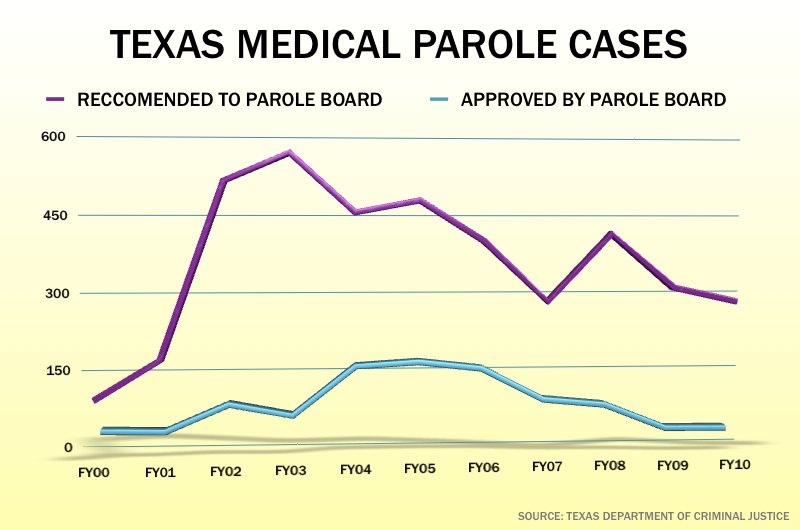
Prison doctors routinely offer up the oldest and sickest of these inmates for medical parole, a way to get those who are too incapacitated to be a public threat and have just months to live out of medical beds that Texas’ quickly aging prison population needs. They’ve recommended parole for 4,000 such inmates within the last decade. But the state parole board, which makes the final decision on “medically recommended intensive supervision,” has only agreed in a quarter of these cases, leaving the others to die in prison — and on the state’s dime.


Texas’ “geriatric” inmates, classified as those 55 and older, make up just 7.3 percent of Texas’ 160,000-offender prison population. But they account for nearly a third of the system’s hospital costs and make three times as many visits to prison medical departments as younger inmates. Elderly inmates have average annual hospitalization costs of $4,700, compared to $765 for inmates under 55. In total, providing inmate medical care costs the state correctional health care system — already facing hundreds of employee layoffs amid a budget shortfall — nearly half a billion dollars a year.


Parole board members say they’re faced with the difficult task of determining whether an inmate is still dangerous and must err on the side of public safety. “You can be sick, have an illness or a disease, and still be a threat,” said board chair Rissie Owens. “Our decisions aren’t based on numbers, on quotas. And we feel like we’re making good decisions.”


But criminal justice and prison funding experts say leaving elderly, terminally ill inmates to waste away behind bars is often unnecessary and exorbitantly expensive. Those costs would be shared with the federal government if the offenders weren’t in state custody.


“These are totally incapacitated inmates, terminally ill inmates, inmates on respirators, who are not paroled at a huge expense to the state and hardship to the inmate’s family because of the nature of a crime they may have committed 20 or 30 years ago,” said Sen. John Whitmire, D-Houston, who chairs the state Senate’s Criminal Justice Committee. “I think it’s largely for political reasons.”


The cost of care


While the total prison population in Texas isn’t growing, it’s quickly aging. The ranks of geriatric inmates are rising by about 6 percent every year, frightening the budget writers who have to figure out how to pay for them. Health care costs are rising too: The average daily medical bill for Texas inmates grows about 4 percent every year — which is low, compared to some states.


The sickest inmates can each cost the state up to $1 million a year in health care costs. If these same inmates were living in nursing homes or hospice facilities, the federal government — through Medicaid — would pay two-thirds of the cost and save Texas taxpayers up to $50 million a year, according to state projections. If the offenders are eligible for Medicare, the feds would pick up the full tab. “We could be transitioning them to some other facility where state taxpayers wouldn’t have to bear the full health care cost,” said Marc Levin, the director of the Texas Public Policy Foundation’s Center For Effective Justice Director, who suggested special nursing homes or hospice centers monitored by parole officers. “It’s a real opportunity to identify some savings without doing anything to endanger public safety.”


But despite the fact that the national one-year recidivism rate for older offenders is miniscule compared to that of younger offenders — 3.2 percent for inmates over 55, compared to 45 percent for inmates between 18 and 29 — an April report by the VERA Institute of Justice, a nonprofit criminal justice policy group, found that the 15 states that allow medical release rarely use it. What stands in the way? Political repercussions, complicated review processes and limited eligibility, the researchers found.


Getting Texas inmates released on medical parole is no easy task. To be eligible for it, an offender can’t be on death row or be serving life without parole, and must be either terminally ill (six months or less to live) or require intensive long-term care, said Dee Wilson, director of the Texas Correctional Office on Offenders with Medical or Mental Impairments. Sex offenders must effectively be in a vegetative state for consideration.


If inmates qualify, the office, in conjunction with the Correctional Managed Health Care Committee, recommends them for medical parole, then submits them to the seven-member Board of Pardons and Paroles for a decision. “It’s all about how long you have to live, and what your prognosis is,” Wilson said. “You can have a terminal illness but still be fully functioning.”


Dying behind bars


The parole board, in turn, relies on a pre-existing condition threshold of sorts. If an inmate with a particular illness commits a crime, Owens said, it’s unlikely he or she will get medical release for that same diagnosis. Some inmates with multiple amputated limbs may look incapacitated, Owens said, but managed to commit their crimes that way. Of the roughly 4,000 inmates prison health officials recommended for medical release in the last decade, the parole board turned down nearly 3,000.


In the last fiscal year alone, more than 440 Texas inmates died in prison. Thirty-one inmates who’d been recommended by medical staff for release died while awaiting the parole board to take up their case; another 26 died after the parole board rejected them for release. Twelve inmates were approved for medical parole but died before they could be sent home.


“There are documented cases where individuals had days or weeks left to live” and were rejected for medical parole, Whitmire said. “I saw no reason why they shouldn’t be paroled so the family could make plans for their funeral.”


Texas is not the only state struggling with skyrocketing prison health care costs and concerns around medical release. Between 1999 and 2007, the number of inmates 55 or older in state and federal prisons grew by more than 75 percent, to 76,000. To date, more than a dozen states have units set aside for elderly inmates; eight have dedicated hospice facilities. Estelle has an impressive medical facility, with a bustling emergency room, high-tech telemedicine equipment and a team of nephrologists that perform 1,800 dialysis treatments a month — sometimes on aggressive or unstable inmates.


“From a medical perspective, I’m comforted that [offenders are] getting a level of care they may not be getting on the street. On the other hand, we’re about to un-employ 363 people,” said Dr. Owen Murray, the chief physician for the University of Texas Medical Branch’s correctional managed care program, which oversees health care for the majority of Texas’ prisoners — and is facing layoffs this summer. “Are there other strategies to reduce our costs? And how do we prevent having to build more expensive units in the future?”


Charles Dill, a 71-year-old offender who started a 20-year sentence in 2000, has been hospitalized multiple times himself for costly heart problems, including getting stents for his carotid arteries. He’s befriended several elderly inmates in Estelle’s geriatric unit, only to watch them die on the ward.


“I’ve seen several of these guys drop over dead,” Dill said, gesturing across a prison dorm room of prosthetic limbs and wheelchairs, adult incontinence products and white-haired men in Coke-bottle glasses. “I guess they completed their sentence.”