Davon's clemency board hearing was yesterday - the decision to turn him down was clearly made before we walked into the room, however. The chair made only passing reference to the thick stack of mail that had arrived in support of Davon's application, and cut me off when I was speaking on his behalf. He made a special point of reading things into the record to justify their determination against him. The county attorney's office can be expected to oppose such applications, but they went out of their way, it seems, to damn him - which was precisely what the board needed and asked for. Not that I'm accusing them of any impropriety - I'm sure they did what they felt was right - just as I'm doing. We just come from different places, and they don't know Davon like I do. As evidenced by their decision yesterday, They don't know him at all.
Pardons in Arizona have nothing to do with mercy or grace, by the way - or even justice for that matter, even when sincere people try to deliver it. Look at what our good governor did to Bill Macumber, the innocent man who has already spent 35 years in prison for murder and may well die there. Convinced beyond any doubt that his conviction was based on perjured testimony and manufactured evidence, the Arizona Board of Executive Clemency unanimously recommended him for a full pardon, which would have gone into effect if Brewer had simply left it alone for 90 days. Instead she quashed it, in the interest of her kind of "justice". Affirming Bill's innocence would have implied his ex-wife's guilt. As she worked for the Maricopa County Sheriff's office at the time she framed him, I suspect Brewer was doing someone with history there a favor. But what do I know?
Sadly, despite his story saturating the media across the country before November 2, the voters in Arizona elected that woman anyway.
As for Davon: the outcome of his hearing was no surprise, really - probably least of all to him - but it was still a disappointment; his little sister left the room abruptly in tears. We did, however, raise awareness about the prosecution of the seriously, mentally ill for their symptoms rather than their criminality, and built a network for prisoners with Hep C and their families. We also entered our objections to the prison industrial complex into the public record (that was the part I think they didn't want to hear). One of our legislators even turned out to corroborate Davon's mom's assertion that Arizona's prisoners aren't getting the medical care they need in there - and that came from a self-described "conservative Republican". I suspect he will pay a price for having done that, which is why I won't name him here. I doubt he would endorse my own take on the system, but he's still one of the few politicians I've ever met with real integrity. I can't think of a single Democrat in this state who would put themselves on the line like that for a convicted violent, crazed felon seeking mercy - much less another Republican.
I'm convinced that clemency boards exist largely to reinforce the illusion that the system we have of doling out punishment in our country is a "just" one that serves the best interests of society at large. By allowing room for pardons and commutations, we suggest that the legal system we live under, as a rule, delivers justice to criminals and victims alike, and that any abuse of power or injustice perpetrated by the state in the process is an exception that needs to be dealt with on a case-by-case basis. If that was the reality, however, our prisons would not be packed almost exclusively with the poor - most of whom have the least ability to do great harm. In a truly just and morally evolved society it is the money-lenders, warmongers and rogue sheriffs of this land who would be doing time for exploitation, mass murder, and kidnapping - not making the rules the rest of us have to live by. They certainly wouldn't be retiring with honors and drawing down our collective dime.
But ours is neither a just nor a moral society - it isn't even a democracy. It is a capitalist republic in which the wealth and power of the few still depends on their ability to co-opt, terrorize, and restrain the many. We literally replaced our plantations with prisons when overt slavery went out of style. America's governments exploit and injure far more innocent and vulnerable people than all our lone criminals combined do. We've even made the perpetuation of victimization and crime an attractive, acceptable industry from which savvy investors can profit.
Thanks, everyone, for all your support through this. Stay with us, please - this fight is much bigger than one young man, and has only just begun. Keep an eye on what's happening with Davon for awhile longer - he went further out on a limb in the interest of prisoner rights and health care than any of the rest of us had to - and risks paying a much higher price now than the one extracted from him at sentencing. We'll see if he's allowed to keep his good time - and make it successfully through the 4 years of probation he has yet to serve -in light of his and his mother's public defiance. I guess we'll also see if the Arizona State Legislature shows any mercy for the honesty and courage of one of their own.
Showing posts with label pardon. Show all posts
Showing posts with label pardon. Show all posts
Friday, November 19, 2010


Thursday, June 24, 2010
TX to AZ: The Politics of Compassion.
Kudos to this reporter for caring about this story. We have some compassionate release hang-ups in Arizona that need some journalistic help, too...maybe there's even a student out there who would want to make it an investigative journalism or research project? Let us know. Time is running out for Davon and his fellow prisoners; even he suggests that there are men far more ill than him who need to be going home before they die. Terminal illness was not included in their sentencing; perhaps sentencing judges should be reviewing such things when people apply for compassionate release.
So, keep hounding the governor - we need to let these folks find decent treatment in order to survive their sentences, or release them so they can die at home. Let her know that more than just a few of us care about this - she doesn't strike me much as the "compassionate" type, after all this with SB 1070.
But if she's really into helping the people of Arizona, then this is one small way she can make a huge difference in the lives of folks who have otherwise been disposed of and forgotten by all but their families - if they even still have connections with them, then the suffering generated by denying medical releases to terminally or chronically, severely ill prisoners is exponentially magnified. Everyone, including the state and our communities, hurts from our inability to embrace our own humanity, and find within ourselves the qualities of Mercy and Grace.
And the effects of the ease with which we detach from the pain of our fellow beings trickle down to the next generation...it is not a kind thing to bestow on them, or much of a gift to leave the world: a callous heart.
And it's all politics. Challenge Brewer to have the courage to step up to this issue and do it right. Word is that too many people since Janet have been approved by the Board of Executive Clemency only to die while sitting on the Governor's desk. Is this governor any less a coward than Napolitano was? I hope so.
- Peg
by Emily Ramshaw
Texas Tribune
June 3, 2010
So, keep hounding the governor - we need to let these folks find decent treatment in order to survive their sentences, or release them so they can die at home. Let her know that more than just a few of us care about this - she doesn't strike me much as the "compassionate" type, after all this with SB 1070.
But if she's really into helping the people of Arizona, then this is one small way she can make a huge difference in the lives of folks who have otherwise been disposed of and forgotten by all but their families - if they even still have connections with them, then the suffering generated by denying medical releases to terminally or chronically, severely ill prisoners is exponentially magnified. Everyone, including the state and our communities, hurts from our inability to embrace our own humanity, and find within ourselves the qualities of Mercy and Grace.
And the effects of the ease with which we detach from the pain of our fellow beings trickle down to the next generation...it is not a kind thing to bestow on them, or much of a gift to leave the world: a callous heart.
And it's all politics. Challenge Brewer to have the courage to step up to this issue and do it right. Word is that too many people since Janet have been approved by the Board of Executive Clemency only to die while sitting on the Governor's desk. Is this governor any less a coward than Napolitano was? I hope so.
- Peg
----------------------
Few Texas Inmates Get Released on Medical Parole by Emily Ramshaw
Texas Tribune
June 3, 2010
A gaunt old man, thick with whiskers and stricken with dementia, writhes under the covers of his bed. Down the hall, doctors monitor elderly diabetics with recently amputated limbs, medicate terminal cancer patients shuffling by with walkers and tether shivering dialysis patients to blood-cleaning machines.
Despite the pacing guards, the handcuffs and the bars on the windows, the geriatric and medical wing at the Estelle Unit in Huntsville looks more like a nursing home than a maximum-security prison.
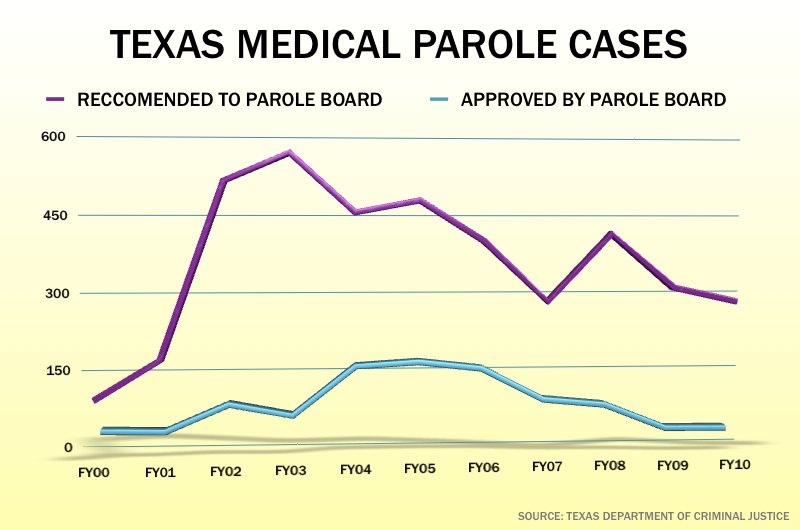
Prison doctors routinely offer up the oldest and sickest of these inmates for medical parole, a way to get those who are too incapacitated to be a public threat and have just months to live out of medical beds that Texas’ quickly aging prison population needs. They’ve recommended parole for 4,000 such inmates within the last decade. But the state parole board, which makes the final decision on “medically recommended intensive supervision,” has only agreed in a quarter of these cases, leaving the others to die in prison — and on the state’s dime.
Texas’ “geriatric” inmates, classified as those 55 and older, make up just 7.3 percent of Texas’ 160,000-offender prison population. But they account for nearly a third of the system’s hospital costs and make three times as many visits to prison medical departments as younger inmates. Elderly inmates have average annual hospitalization costs of $4,700, compared to $765 for inmates under 55. In total, providing inmate medical care costs the state correctional health care system — already facing hundreds of employee layoffs amid a budget shortfall — nearly half a billion dollars a year.
Parole board members say they’re faced with the difficult task of determining whether an inmate is still dangerous and must err on the side of public safety. “You can be sick, have an illness or a disease, and still be a threat,” said board chair Rissie Owens. “Our decisions aren’t based on numbers, on quotas. And we feel like we’re making good decisions.”
But criminal justice and prison funding experts say leaving elderly, terminally ill inmates to waste away behind bars is often unnecessary and exorbitantly expensive. Those costs would be shared with the federal government if the offenders weren’t in state custody.
“These are totally incapacitated inmates, terminally ill inmates, inmates on respirators, who are not paroled at a huge expense to the state and hardship to the inmate’s family because of the nature of a crime they may have committed 20 or 30 years ago,” said Sen. John Whitmire, D-Houston, who chairs the state Senate’s Criminal Justice Committee. “I think it’s largely for political reasons.”
The cost of care
While the total prison population in Texas isn’t growing, it’s quickly aging. The ranks of geriatric inmates are rising by about 6 percent every year, frightening the budget writers who have to figure out how to pay for them. Health care costs are rising too: The average daily medical bill for Texas inmates grows about 4 percent every year — which is low, compared to some states.
The sickest inmates can each cost the state up to $1 million a year in health care costs. If these same inmates were living in nursing homes or hospice facilities, the federal government — through Medicaid — would pay two-thirds of the cost and save Texas taxpayers up to $50 million a year, according to state projections. If the offenders are eligible for Medicare, the feds would pick up the full tab. “We could be transitioning them to some other facility where state taxpayers wouldn’t have to bear the full health care cost,” said Marc Levin, the director of the Texas Public Policy Foundation’s Center For Effective Justice Director, who suggested special nursing homes or hospice centers monitored by parole officers. “It’s a real opportunity to identify some savings without doing anything to endanger public safety.”
But despite the fact that the national one-year recidivism rate for older offenders is miniscule compared to that of younger offenders — 3.2 percent for inmates over 55, compared to 45 percent for inmates between 18 and 29 — an April report by the VERA Institute of Justice, a nonprofit criminal justice policy group, found that the 15 states that allow medical release rarely use it. What stands in the way? Political repercussions, complicated review processes and limited eligibility, the researchers found.
Getting Texas inmates released on medical parole is no easy task. To be eligible for it, an offender can’t be on death row or be serving life without parole, and must be either terminally ill (six months or less to live) or require intensive long-term care, said Dee Wilson, director of the Texas Correctional Office on Offenders with Medical or Mental Impairments. Sex offenders must effectively be in a vegetative state for consideration.
If inmates qualify, the office, in conjunction with the Correctional Managed Health Care Committee, recommends them for medical parole, then submits them to the seven-member Board of Pardons and Paroles for a decision. “It’s all about how long you have to live, and what your prognosis is,” Wilson said. “You can have a terminal illness but still be fully functioning.”
Dying behind bars
The parole board, in turn, relies on a pre-existing condition threshold of sorts. If an inmate with a particular illness commits a crime, Owens said, it’s unlikely he or she will get medical release for that same diagnosis. Some inmates with multiple amputated limbs may look incapacitated, Owens said, but managed to commit their crimes that way. Of the roughly 4,000 inmates prison health officials recommended for medical release in the last decade, the parole board turned down nearly 3,000.
In the last fiscal year alone, more than 440 Texas inmates died in prison. Thirty-one inmates who’d been recommended by medical staff for release died while awaiting the parole board to take up their case; another 26 died after the parole board rejected them for release. Twelve inmates were approved for medical parole but died before they could be sent home.
“There are documented cases where individuals had days or weeks left to live” and were rejected for medical parole, Whitmire said. “I saw no reason why they shouldn’t be paroled so the family could make plans for their funeral.”
Texas is not the only state struggling with skyrocketing prison health care costs and concerns around medical release. Between 1999 and 2007, the number of inmates 55 or older in state and federal prisons grew by more than 75 percent, to 76,000. To date, more than a dozen states have units set aside for elderly inmates; eight have dedicated hospice facilities. Estelle has an impressive medical facility, with a bustling emergency room, high-tech telemedicine equipment and a team of nephrologists that perform 1,800 dialysis treatments a month — sometimes on aggressive or unstable inmates.
“From a medical perspective, I’m comforted that [offenders are] getting a level of care they may not be getting on the street. On the other hand, we’re about to un-employ 363 people,” said Dr. Owen Murray, the chief physician for the University of Texas Medical Branch’s correctional managed care program, which oversees health care for the majority of Texas’ prisoners — and is facing layoffs this summer. “Are there other strategies to reduce our costs? And how do we prevent having to build more expensive units in the future?”
Charles Dill, a 71-year-old offender who started a 20-year sentence in 2000, has been hospitalized multiple times himself for costly heart problems, including getting stents for his carotid arteries. He’s befriended several elderly inmates in Estelle’s geriatric unit, only to watch them die on the ward.
“I’ve seen several of these guys drop over dead,” Dill said, gesturing across a prison dorm room of prosthetic limbs and wheelchairs, adult incontinence products and white-haired men in Coke-bottle glasses. “I guess they completed their sentence.”
Subscribe to:
Posts (Atom)